NEWS
The Place announces new cohort of Choreodrome artists 2026
The Place’s annual artist development programme enables dance artists to investigate new performance ideas
Share
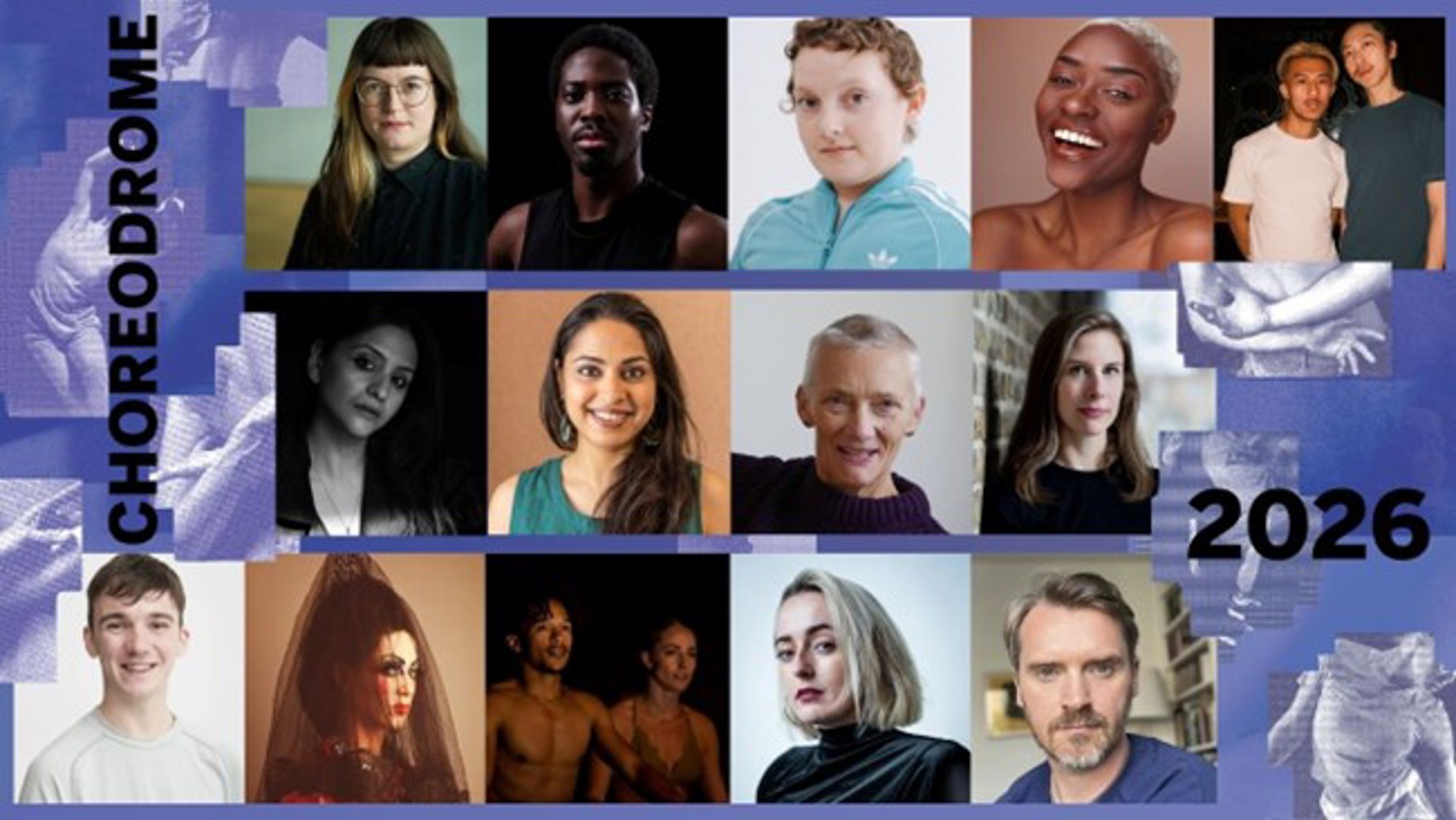
Photos by various, original artwork by Moe Nakagawa
Every summer, The Place, London’s leading centre for dance and performance, is excited to welcome a new annual cohort of Choreodrome artists to its building, to research and work on new ideas, pushing forward dance innovation.
Choreodrome is one of the most important dance development programmes in the UK, enabling artists to explore new territories and have access to tailored support. It is part of The Place’s range of artist development opportunities designed to create a space for artists to explore new territories and facilitate the growth of independent artists’ creativity and sustainability. The 14 artists selected this year are delving into a wide range of practises and creative ideas including krump, improvisation, minimalism, archiving, Flamenco, Kuchipudi and Africanfuturism.
Speaking of the programme, Polly Cuthbert, Artist Development Producer at the Place, says: “Choreodrome is a vital part of the UK’s dance ecology, supporting artists to develop bold new work that goes on to reach audiences at The Place, but also nationally and internationally. At its core, Choreodrome is about experimentation: a space to test ideas, take risks, and embrace the unexpected. This spirit of exploration is essential to the creative process, and we’re excited to see what emerges from this year’s artists.”
The creation of new dance thrives best in collaboration, and as always, The Place works with a number of partners and experts in their field, in order to best support a wide range of artists from different practices and with different needs. The Booster Packs are aimed at supporting artists in a specific area of choreographic practice or research, and this year, The Place is excited to be working with Just Us Dance Theatre, Bradford Arts Centre and London Contemporary Dance School to provide tailored support to three artists. The Bradford Arts Centre Booster Pack is supporting Kesha Raithatha, the Knowledge Exchange Booster Pack is supporting emilyn claid and the Hip Hop Booster Pack is supporting Isaac Ouro-Gnao.
For 2026, the Choreodrome residency programme has been redesigned to better support artists at different stages of the making process and reflect the rising costs of making new work.
This year, two levels of commissioning support are available:
• £2,000 commissions
• 1 week of studio space
• pitching opportunity at Choreodrome: making progress for ideas in the first stage of development that have had limited/no studio development time.
• £4,000 commission
• 2 weeks of studio space
• performance opportunity at Choreodrome: making progress for ideas that have been substantially developed with at least one previous studio-based research and development phase.
The 14 artists and collectives who were awarded this year’s Choreodrome Research Residencies are:
Annie Edwards - a London-based dance artist from Brighton and graduate of London Contemporary Dance School, who has performed nationally and internationally with companies including Candoco Dance Company, Boy Blue, Thick & Tight, Paraorchestra and ZooNation. Her contemporary and hip-hop practice centres on improvisation, collaboration and disabled embodiment. Annie received DYCP Arts Council funding for her investigation into disability informed movement practices.
In a world that romanticises fatigue and rewards disassociation, it is left to those that can’t keep up to invent new realms. What remains of our practise when we dive deeper rather than further away? Inspired by minimalism, this ambitious solo embraces durational movement states that transform over time, resisting physical extremes or climaxes. It experiments with choreography as a safety net for authentic expression- by combining improvisation with pain informed practices, this work creates a live space for genuine catharsis and curiosity of the body. It ponders the value of ‘less’, and who is permitted the choice to do it.
Annie Hanauer - a contemporary dance artist and choreographer, who has worked across countries and contexts for 18 years, with an established presence on international stages as both a dancer and choreographer, using disabled-led collaboration to joyfully disrupt norms around the body; she was the 2024–25 Clore Dance Fellow.
One, Two is a new group work confronting the fetishisation of women with limb differences and disabled people, imagining a band of dancing rockstars who channel crip pride into a joyful, punky and tender performance that reclaims power and authorship of female disabled bodies.
Eleanor Sikorski – works in dance as a performer, choreographer, rehearsal director and teacher, as well as a filmmaker and comics artist. Her choreographic work includes solo performances, stand-up sets, music videos, group pieces and sculpture. She combines formal elements with humour and off kilter storytelling. In 2015 she formed dancer collective ‘Nora’ with Stephanie McMann and Flora Wellesley Wesley. In 2019, with Lewys Holt, she co-founded Roadhouse, an ongoing night of improvised dance performance in Leeds, hosting performers from across the UK. In 2025 Eleanor became a mother.
Her piece proposes the Rube Goldberg Machine as a choreographic and scenographic device. Named after their creator, cartoonist Rube Goldberg, the machines are chain-reaction contraptions which perform simple tasks in overly complicated ways. Working with anticipation, surprise, climax and anticlimax, she will design simple, sequential mechanisms which can be operated by the body, setting off a series of unexpected events and building an atmospheric and unpredictable environment. With this light-hearted work she hopes to reframe function as expression and expose the pleasure of bringing impossible contraptions to life.
emilyn claid — was a ballet dancer in Canada in the 1960s. In the 1970s she was co-founder of experimental collective X6 Dance Space in London and in the 1980s was artistic director of Extemporary Dance Theatre. In the 1990s emilyn choreographed for companies such as Phoenix and CandoCo and, as an independent dance artist, made a series of iconic solo works as a lesbian-queer artist. She wrote and published FALLING Through Dance and Life, (Bloomsbury 2021). Working between live art and dance theatre, emilyn has recently toured a solo show UNTITLED (2022-24) and choreographed The Trembling Forest (2025).
Contending with Archive is a project that treats my extensive performance archive as a living site for making. Rather than preservation, the archive becomes a place of resistance: contested, queered and re-animated. The work combines autoethnographic storytelling with film drawn from 8mm, VHS, DVDs, cassettes, slides and photographs. Central to the project is a wrinkling of time, where past and present, youth and age fold into one another, allowing archive and presence to remain in constant dialogue. I will be developing a series of intimate, salon-style performances, as testing grounds for material that might later culminate in a full-length performance.
Ghost and John - two queer married artist-researchers from Hong Kong working across performance, writing, and visual arts. They make embodied works about queer migrant experiences. In their past productions, they present fragmented memories of traumatic experiences related to displacement, relationships, social movement, and technological interaction. As queer migrant artist-researchers from Hong Kong, Ghost and John have developed a dynamic and embodied practice that examines the intricacies of the body and nature, technological advances and folklore accompanying history. They are two of the six co-founders of Hidden Keileon CIC.
Monster Play is an R&D project exploring how to stage a new dance-theatre work rooted in Ghost and John’s Embodied Ecology research. Working as queer and migrant dancers and creative technologists, they test how movement, projection, interactive technology and vocabularies from horror theatre can address environmental destruction, war and ecocide through an interdisciplinary performance language. Responding to environmental destruction caused by human activity, war and ecocide, this project asks: how do these violences register within the body? What monsters do we carry collectively? And how might embodied practice transform fear, grief and rage into care and resilience?
Isaac Ouro-Gnao — a Togolese-British multidisciplinary artist, somatic trauma therapist and journalist, who blends magical realism, Africanfuturism and West African spirituality across dance, film and interdisciplinary work exploring childhood, grief, trauma and mental health, informed by training in hip hop, contemporary and Africana techniques and an MSc in Creative Arts and Mental Health.
you’re a man now, boy is a hip hop and Africana dance theatre production. The work delves into how childhood trauma, childhood adverse experiences (ACEs), and positive childhood experiences (PCEs) shape adult mental health, and how we find healing – individually, collectively, holistically, and spiritually. The production is a non-linear narrative story about child deities born out of necessity to protect, care for, and heal children as they grow up as Black men*.
* using the terms Black and men inclusively, to mean anyone of and/or mixed African descent, including throughout the diasporas, who self-identifies as Black, a man, male or transmasc.
Joe Moran - a British-Irish artist and choreographer working across performance, film, choreographic drawing, facilitation and curatorial practice, with an emphasis on expanded choreography and the physicality of emotion. His work centres the body as a site of complex subjectivities and political tension, often engaging queering as a critical strategy across theatre, gallery and festival contexts internationally.
Now We Are Dead is a new dance work for the stage navigating themes of loss, displacement and cultural identity. Prompted by personal experience, including a growing dislocation from Irish culture and community following the death of my parents, the work moves beyond the personal to consider wider systemic desolation and making at a time of socio-geopolitical collapse that feels unfathomable. Research is informed by queer pessimism, asking what is made possible when we admit defeat, and foregrounds queer defiance and the defiance of emotion.
Kesha Raithatha - a boundary-pushing dancer and choreographer merging the precision of Kathak with contemporary fluidity, reimagining contemporary South Asian dance and creating experimental, socially engaged performances rooted in cross-cultural dialogue. Kesha was a Work Place artist at The Place, is a resident creative at Curve Theatre Leicester and an Associate Artist with Aakash Odedra Company.
Threads (working title) is a choreographic work exploring how clothing shapes identity, memory and cultural authorship through a contemporary South Asian lens. Drawing on enclothed cognition, it considers how what we wear alters behaviour and embodiment, while garments act as living archives — carrying labour, lineage and the imprint of bodies that came before. Set against this is the tension of mass production and extraction, where meaning is stripped and cycles are broken. Moving between inheritance and disruption, the work asks what we carry, what we wear, and how, in many ways, we are wearing each other.
Maiya Leeke – a multidisciplinary creative artist working as a performer and choreographer, with a practice that spans contemporary dance and collaboration across theatre, film and large-scale performance. Her work has been supported by institutions including Sadler's Wells, as a Young Associate 2023-2025, the Arts Foundation Fellow Future Awards, as a shortlisted artist, and the Jerwood Choreographic Research Award. She has danced with companies such as Candoco Dance Company, Cathy Waller Company, CoDa Dance Company and Paraorchestra.
She Dreams. She Flies! is a fusion of contemporary dance and aerial circus, researching the potential of equipment to reimagine possibility, refusing to accept a world that says 'that's just the way it is'. A love letter to the people who dream the wildest dreams.
MANACAN - a South African dance and music company based in London, led by Ciara Baldwin and Nathan Bartman. They choreograph, compose, perform, and tour original work rooted in their heritage. Their style is earthy and physical, blending African and contemporary forms with original music. Their work explores primal, human themes through movement and sound. Alongside international touring, they lead workshops for all ages and abilities, sharing tools that encourage connection, growth, and collective strength.
Kaggen and the Moon is a playful yet profound solo dance-theatre work, blending Khoisan lore with contemporary performance. Through movement, storytelling, and live sound, it explores change, forgiveness, and renewal, a ceremonial return to myth, land, and the cycles we all share. At its heart is Kaggen, the ancient trickster of the San and Khoi people: part man, part mantis, part memory. He shapes a world where the Moon is a living being, and in a moment of anger, shatters it, setting in motion the cycle of death and rebirth.
Matthew Rawcliffe - a dance artist based between Manchester and Copenhagen, creating inclusive and sensory-led performances for neurodivergent audiences and people with profound and multiple learning disabilities. He is known for winning BBC Young Dancer 2019 and performing the title role in Pinocchio at the Danish Royal Theatre.
DOLLAR BILLS is a new one-on-one performance for adults with profound and multiple learning disabilities (PMLD). Exploring splendour and excess through a sensory lens, the performance looks at the ugliness of greed - what happens when we go too far, when we get lost in the desire of wanting more. The work is co-created with and performed by dance artist Zara Phillips.
Oluwatosin Omotosho - a Nigerian-born, London-based dance artist and choreographer working across theatre, film, television and commercial performance, with a practice rooted in hip hop, street styles, Afro-dance, jazz, contemporary movement, spoken word and text. She has performed with artists including Little Simz, TYLA, Lenny Kravitz and RAYE, and across major stages such as Glastonbury, the BRIT Awards and the MTV EMAs.
The Aunties: House of Masks is a dance-theatre work blending hip hop, street styles and spoken word to explore the role of “aunties” in African diaspora communities, using humour and storytelling to examine cultural expectation, identity and the hidden vulnerabilities beneath performances of authority and care.
Patricia Langa — a London-based, Barcelona-born dance artist, choreographer, and director of multidisciplinary performance company, Eric Longa. She has performed internationally with companies and directors including Rambert, Lea Anderson, Ridley Scott, and LA Philharmonic, creating works that explore flamenco, queer histories, and Spanish culture, showcased at venues such as Southbank Centre, V&A East, Soho Theatre, and major LGBTQI+ spaces. She is an associate artist with Corali Dance Company
Patricia will undertake an R&D exploration centred on Federico García Lorca (Spanish poet, playwright, and visual artist) and Francisco Franco (Spanish dictator) to develop her first full-length solo performance. She will embody both figures, exploring their contrasting impacts on flamenco through movement, mime, drag, spoken word, humour, and film, creating a dialogue between Lorca, a voice of resistance, and Franco, a symbol of authoritarian control, foregrounding art as a vital tool for memory, resistance, and liberation.
Payal Ramchandani — a Newcastle-based dance artist and choreographer whose thinking is rooted in the South Indian classical dance form Kuchipudi. As one of the only artists working at this scale with the form in the UK, she is a flag-bearer - carrying it into contemporary contexts and ideologies through interdisciplinary, socially engaged work. Spanning theatre, festivals, galleries and beyond, her work uses this classical vocabulary as a tool to access truth, investigate ideas and foster empathy through transformation.
Footprints in Ash (working title) is a dance-theatre work in early R&D, exploring caste and colour hierarchies through the paradox of communities who are simultaneously essential and excluded. Drawing on Indian classical movement vocabulary, it examines how systemic biases play out in spaces of ritual and daily life, in communities including the Dom - corpse burners, and the Madiga - historically tied to the leather industry, among many others - who remain unnamed. The work reclaims darkness, often mis-associated with impurity and fear, as a space of gestation and protection. Combining movement, music and dramaturgy, it asks who is seen, and who is made invisible.